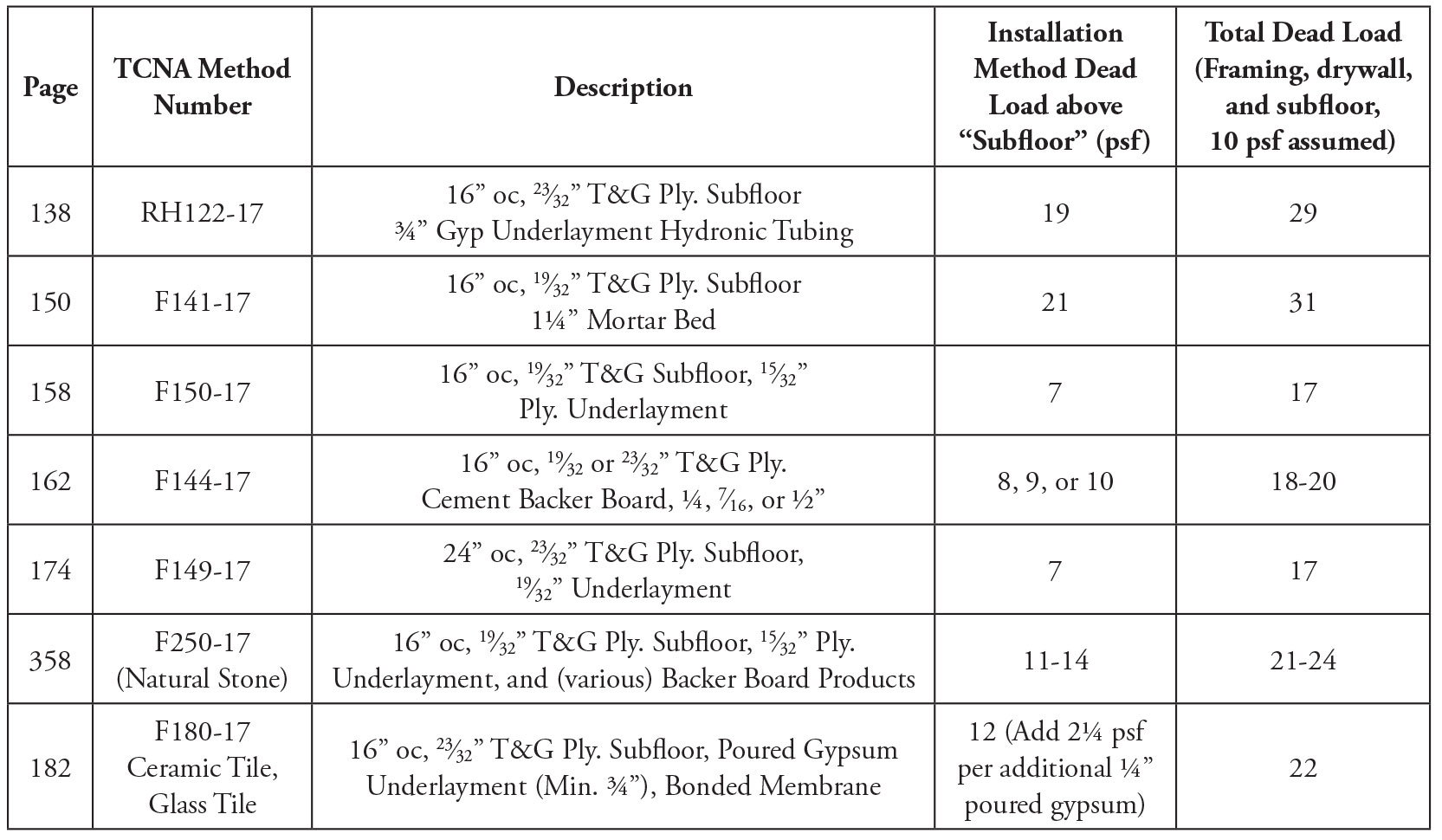
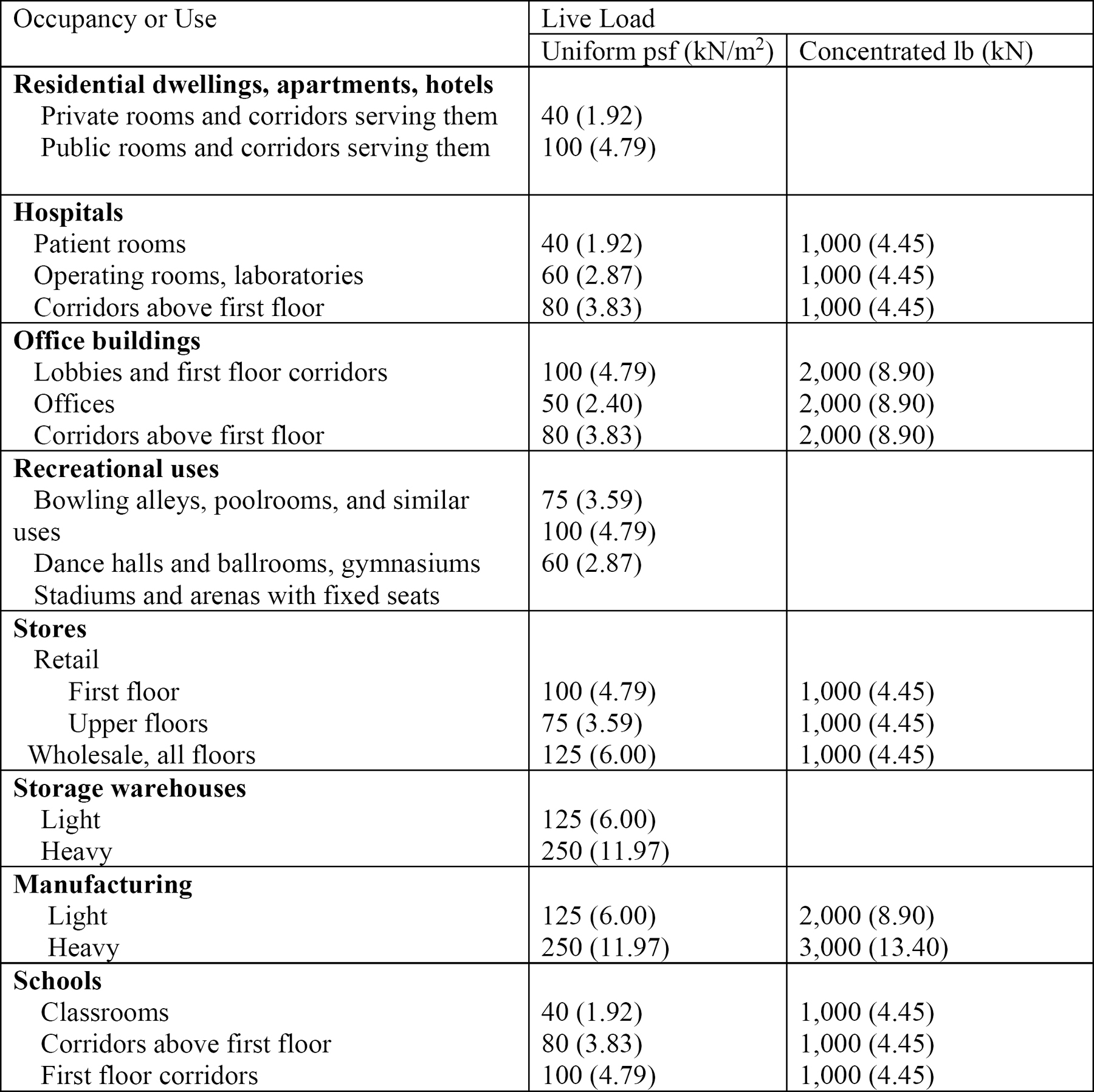
Tile industry associations recommend special total load deflection limits the following tables list the components and weights of typical floor systems along with the deflection limits that apply.
Live and total load deflection for title floor.
Camber is a curvature in the opposite direction of the dead load deflection curve.
The tile council of america recommends that deflection be limited to l 360 l span length in inches under total load for ceramic tile.
Figure 2 live loads and deflection limits are set by code.
3 8 2 cast in place concrete floors.
With an evenly distributed live load of 30 psf which the tables show the floor is able to support the total weight on the floor would be about 3 360 pounds.
These tables are from the icc international residential code.
Therefore the live load deflection is of concern in the completed structure.
The amount of flex depends on the magnitude of the load applied span of the member and stiffness of the member.
Examples of code prescribed deflection limits and live load values are.
Span rafter with a 4 12 slope and no ceiling attached has an allowable deflection of l 180 which is twice the deflection allowed for floor joists.
Step 2 span table.
Allowable deflection for this floor joist is approxi mately 1 2 in.
Typically for better performing floors minimal defection is desired.
The table of contents indicates.
Now consider the same floor joist supporting stone tile flooring such that floor dead load is now 20 psf.
Design substrate for total load deflection not exceeding l 360 as measured between control or expansion joints.
Bedrooms and habitable attic floors l 360 30 psf.
These limits are based on live loads and activities experienced in specific rooms of a house.
However the limit on total deflection is span 720 resulting in the need for total deflection to be only 0 50 half of the 1 00 value for span 360.
Select the appropriate table in span tables for joists and rafters.
The dead load deflection is usually compensated by cambering.
Calculating dead loads the prescriptive tables of the irc detailing continu.
When the dead load is applied to a cambered beam the curvature is removed and beam becomes level.
Typical deflection limits referenced in code books are l 360 l 240 or l 180.
The subfloor areas over which stone tile is to be applied must be designed to have a deflection not exceeding l 720 of the span.
If we use the same joist total deflection will be 1 50 1 25 0 25.
Chapter 3 of the international residential code irc provides the maximum allowable deflection for a given structural member floor roof wall etc.